
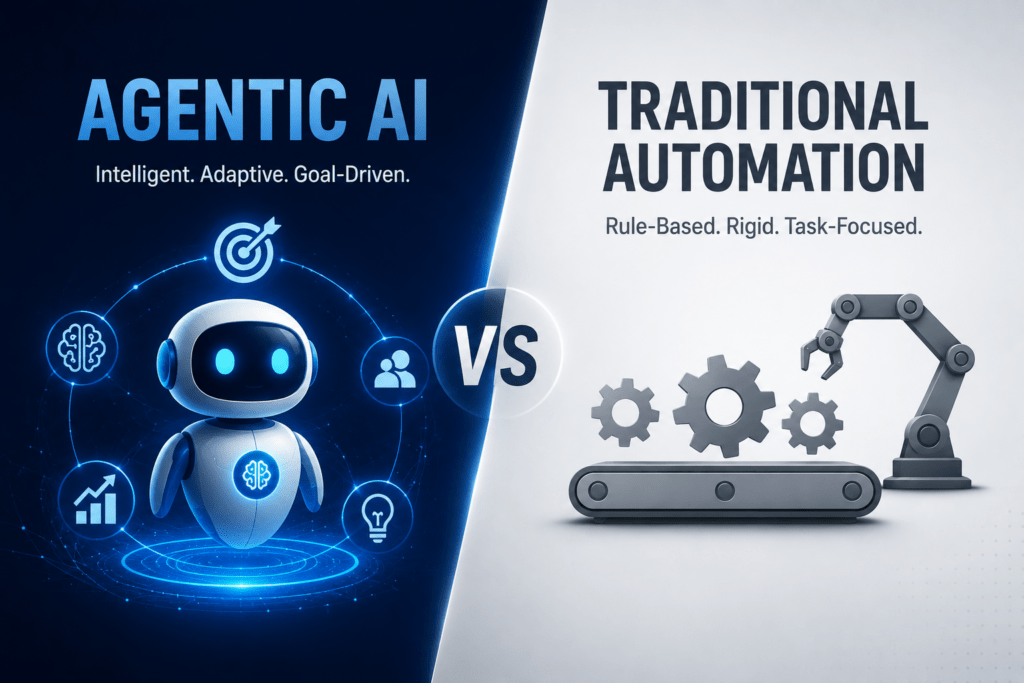
Three different things get called “automation” in lending conversations. They are not the same technology, they do not fail in the same places, and they do not produce the same compliance evidence. Most lenders are operating all three simultaneously without a clear picture of which is which.
This article draws the distinction cleanly and explains what it means for Australian non-bank lenders and asset finance providers in 2026.
Three Generations of Lending Automation
Generation 1 – Rules-Based Automation
Rules-based automation executes a fixed set of instructions when specific conditions are met. If the credit score is above a threshold, advance to the next stage. If the declared income exceeds the required serviceability ratio, pass. If the document type field contains a specific value, route to the correct queue.
This is the automation most lenders built first. It is fast, consistent, and fully transparent. Every outcome can be traced to the exact rule that produced it. The logic can be inspected, updated, and defended to a regulator on demand.
The limitation is not speed. Rules-based automation is very fast. The limitation is rigidity. It can only handle situations that were anticipated when the rules were written.
Generation 2 – Workflow Automation
Workflow automation adds orchestration to rules-based logic. It connects multiple systems, manages sequences of tasks, triggers actions across platforms, and handles more complex multi-step processes than a single rules engine can manage.
A workflow automation system can route a document received by email into the origination system, trigger a notification to the assessor, set a deadline, and escalate if the deadline passes. It coordinates activity across parties and systems rather than executing a single conditional check.
The limitation of workflow automation is that it requires clean, structured inputs. It can move a document from one place to another. It cannot read the document, determine what type it is, extract the data from it, or judge whether the data is consistent with what the application says.
When inputs are unstructured or unexpected, workflow automation stalls or escalates everything to a human. It has no capacity to reason about what to do when the inputs do not match the anticipated pattern.
Generation 3 – Agentic AI
Agentic AI is goal-driven rather than instruction-driven. It receives an objective, breaks it into steps, executes those steps using connected data and tools, observes the result, and continues until the objective is met or an exception requires human judgment.
Where rules-based automation asks “does this match a condition?” and workflow automation asks “what is the next step in the sequence?”, agentic AI asks “what needs to happen to move this forward, and how do I do it with what I have?”
Agentic AI is capable of autonomous decision-making, transforming financial services by automating workflows, personalising advice and reshaping roles, while also raising critical challenges around governance, fairness and risk.
The key practical difference is that agentic AI handles unstructured inputs. It can read a bank statement in PDF format, determine it is a bank statement from a specific institution, extract the transaction data, categorise the income and expense items, and produce a structured output, all without being given a template for that specific institution’s document format.
Where Each Generation Breaks Down
What Rules-Based Automation Cannot Handle
Rules-based automation breaks when the input does not match what the rules were designed for.
A self-employed borrower who draws income through a trust structure does not fit the income verification rules written for a PAYG employee. A bank statement from a non-major institution that uses a different transaction labelling convention does not match the expected field values. An application with a name discrepancy between the loan agreement and the identity document triggers an escalation rather than a resolution.
None of these are complex problems. They all require a small amount of judgment about what is actually happening. Rules-based automation has no mechanism for that judgment. It escalates.
What Workflow Automation Cannot Handle
Workflow automation breaks on unstructured content and contextual complexity.
It can route a document that arrives correctly labelled in the right format. It cannot interpret a document that arrives as a scanned image, determine what information it contains, extract that information, or check whether the information is internally consistent.
It can trigger an alert when a condition has been outstanding for more than five days. It cannot assess whether the condition is likely to be resolved or whether the application should be escalated based on what the file contains.
What Agentic AI Does Differently
Agentic AI handles both of these failure modes because it reasons about content rather than just processing structure.
An agentic AI agent receiving a scanned bank statement does not look for field values in expected positions. It reads the document, identifies what it is, extracts the relevant data, checks it against the rest of the file, and flags the specific discrepancy or gap that needs attention. When the inputs are messy, it works through the mess rather than stopping at it.
Traditional systems reject or flag applicants with non-traditional income or a thin credit file. Agentic AI reads the full picture in real time and makes a judgment call.
The Core Difference: Executing Instructions vs Reasoning Toward a Goal
How Rules-Based Automation Processes a Loan Application
A rules-based system receives the application data, runs each field against its configured rules, passes or fails each check, and produces an output. The process is deterministic: the same inputs always produce the same output.
The system does not know why a rule exists. It does not consider whether a rule is appropriate for the specific borrower. It applies the rule and moves on.
How Workflow Automation Processes a Loan Application
A workflow automation system orchestrates the sequence of steps that the application needs to pass through. It assigns the application to an assessor, sends a document request to the borrower, sets a follow-up reminder, routes the file when the assessor completes their review, and triggers the next stage.
The system does not read the documents. It moves them. The actual assessment still happens in the systems and people the workflow connects, not in the workflow itself.
How an Agentic AI Agent Processes a Loan Application
An agentic AI agent works the application file the way a skilled processor would, in a defined sequence, with a log of every step.
It reads the submitted documents and classifies each one. It extracts the income data from payslips and bank statements and runs cross-document validation. It checks the application against the credit policy rules and flags the specific criteria that are borderline. It confirms which conditions are outstanding and which have been verified. It produces a prepared file for the human assessor to review.
The assessor opens a file that has already been worked, not a raw application. Their time goes to the judgment that requires their expertise.
The Document Problem: Where Most Automation Fails
Why Documents Are the Hardest Part
Most of the information a lender needs to assess a loan application arrives as unstructured documents. Payslips in different formats from different payroll systems. Bank statements from different institutions with different transaction labelling conventions. BAS statements. Tax returns. Notices of assessment. Identity documents in varying formats.
None of these arrive as clean structured data. They arrive as PDFs, some of them image-based rather than machine-readable, each with its own layout and its own conventions.
Rules-based automation and workflow automation were not built for this. They handle the workflow around documents, not the documents themselves.
Document classification drops from 10 to 15 minutes to under 20 seconds with AI document agents. Manual funding-packet review runs 40 minutes to 3.5 hours per application.
What Happens to Unstructured Documents in a Rules-Based System
A rules-based system that receives an image-based bank statement cannot read it. It logs the receipt of a document in a defined field and routes the file to an assessor who will read it manually.
The automation has handled the routing. The reading, the extraction, and the verification are still manual.
What Agentic AI Does With the Same Documents
An agentic AI agent with document parsing capability receives the same image-based bank statement and reads it. It identifies the institution, extracts the transaction data, categorises credits and debits, identifies income deposits and their frequency, and produces a structured output that shows the income picture across the statement period.
The same task that took 20 to 30 minutes of manual assessor time happens in seconds, with a complete log of what was extracted and how.
Compliance and Audit Trails: The Critical Comparison
What Rules-Based Automation Produces as Evidence
Rules-based automation produces a clear, deterministic audit trail. Every decision can be traced to the exact rule that produced it. The rule version is known. The input values are recorded. The output is reproducible.
This is excellent compliance documentation for the decisions rules-based automation makes. The problem is that the decisions rules-based automation makes are a small fraction of what ASIC and AUSTRAC actually require.
What Workflow Automation Produces as Evidence
Workflow automation produces a log of steps completed: document received, application routed, assessor notified, reminder triggered, stage advanced. It shows that the process was followed. It does not show what was assessed or how the assessment was conducted.
For ASIC’s RG 209 requirements, this is insufficient. The documentation must show what inquiries were made, what was verified, and what the basis of the suitability assessment was. A workflow log shows that steps occurred. It does not show what happened within those steps.
What Agentic AI Produces as Evidence
An embedded agentic AI agent produces a timestamped log of every action it took, the specific rule or policy it was checking, the specific data point it was evaluating, and the result. It shows not just that a step occurred but what the step examined and what it found.
For income verification, the audit trail shows which documents were read, what income figures were extracted, how they were compared against the declared income, and what the discrepancy was if one existed. This is the kind of documented evidence that ASIC’s responsible lending guidance actually requires.
What ASIC and AUSTRAC Require
ASIC’s RG 209 requires lenders to demonstrate that their assessment process was systematic, consistently applied, and adequately documented. The documentation must be sufficient to produce a written copy of the assessment on request and must be retained for seven years.
AUSTRAC’s AML/CTF obligations require that compliance checks were conducted, what the result was, and that the logic applied can be reconstructed over a seven-year period. For automated systems, this extends to requiring that the version of the rules in use at the time of each decision can be identified and reviewed.
The credit decision itself, governed by explicit rules, versioned, auditable, and defensible, sits at the centre of every loan origination process for a reason. AI systems that evaluate creditworthiness are classified as high-risk under the EU AI Act: not prohibited, but subject to a demanding regime of governance, documentation, and meaningful human oversight.
While the EU AI Act does not apply in Australia, the governance principle it articulates, covering explicit rules, version control, meaningful human oversight, and a full audit trail, describes exactly what ASIC and AUSTRAC expect from Australian lenders operating automated decisioning systems.
The Embedded vs Standalone Dimension
Standalone AI Tools vs Embedded Agents
Most lenders who have introduced AI into their operations have done so through standalone tools. A bank statement analysis tool that runs outside the origination system. A document parser that a staff member initiates manually. A KYC verification service with a separate login.
Standalone tools produce capability in isolation. They do not produce a connected workflow. The assessor still has to initiate the tool, interpret the output, and enter the results into the system manually. The coordination overhead does not disappear. It shifts.
Bottlenecks don’t live in the AI. They live in the whitespace between systems that unified execution eliminates. Banks keep adding AI to the intake stage and then watching loans stall in the same underwriting queue.
Why the Architecture Matters as Much as the Technology
An embedded AI agent lives inside the lending platform. It reads from and writes to the same records the operations team uses. Its outputs are available in the system immediately, without manual transfer.
When an embedded AI agent verifies income, the result is in the application record. When it flags a discrepancy, the flag appears in the assessor’s queue. When it monitors an account for arrears signals, it does so against the live contract management records.
The architecture that determines where AI plugs into the workflow, how it is governed, and how its outputs are logged is the long-term commitment. The AI capability itself is replaceable. The architecture is not.
People in Control: The Governance Principle
Why Agentic AI Is Not Autonomous Credit Decisioning
The shift from rules-based automation to agentic AI does not mean handing credit decisions to an autonomous system. It means changing what the human assessor is doing when they make that decision.
In a rules-based operation, the assessor’s role is to handle everything the rules cannot. They read the documents the system cannot read, assess the situations the rules were not written for, and make the judgment calls that require context.
In an agentic AI operation, the assessor’s role changes. The documents have been read. The data has been extracted and validated. The policy rules have been checked. The assessor reviews the agent’s prepared output and applies their judgment to the cases that require it.
The credit decision is still the assessor’s. What changes is the quality and completeness of the information available to them when they make it.
What Each Generation Leaves to Human Judgment
Rules-based automation leaves everything messy to human judgment. Unstructured documents, edge cases, anomalies, and exceptions all escalate to a person.
Workflow automation leaves content assessment to human judgment. The system coordinates the flow, but the actual reading and evaluation of what is in the file is manual.
Agentic AI leaves final credit judgment to a person. The mechanical work, including reading, extracting, validating, and checking, is handled by the agent. The judgment work, covering whether the borrower is creditworthy, whether the application meets the spirit of the policy, and whether an exception is worth making, stays with the assessor.
The distinction Gartner draws between human-in-the-loop and human-out-of-the-loop is the relevant governance line. Credit decisions in regulated Australian lending require a human in the loop. Agentic AI is designed to support that loop, not replace it.
What This Means for Australian Asset Finance Lenders
Where Most Lenders Currently Sit
Most Australian non-bank lenders and asset finance providers are operating a combination of generation one and generation two automation. They have rules engines that handle structured decisions and workflow tools that coordinate their processes. They have staff who handle everything the automation cannot.
The result is a process that is faster than it was five years ago but still depends heavily on assessor time for document reading and manual interpretation.
The Practical Progression
The progression from automation to agentic AI is not a replacement. It is an addition. Rules-based automation continues to handle what it was always good at: deterministic checks on structured data, consistently applied policy rules, reproducible outcomes. Workflow automation continues to coordinate the process and manage the sequence of steps.
Agentic AI layers over this to handle what neither generation could: reading and interpreting unstructured content, reasoning about what is needed to advance an application, monitoring the portfolio continuously rather than reactively, and producing the documentation that compliance obligations require.
The enterprise agentic AI software market is projected to grow from $1.5 billion in 2025 to $41.8 billion by 2030, representing a 175% five-year compound annual growth rate, almost twice the early growth trajectory of generative AI.
This growth reflects adoption across industries, but the lending-specific driver is simpler. The document and coordination work that still consumes most of the time in a loan origination process is exactly the work agentic AI is designed for.
ORION’s Embedded Agentic Workforce in This Context
The Lender Platform by Credit Objects embeds six specialist AI agents directly inside the platform: the AI Credit Assessor, AI Settlement Officer, AI Collections Officer, AI Customer Service Agent, AI Executive Analyst, and AI Compliance Assistant.
Each agent operates within the platform’s workflow, governed by the lender’s configured business rules, with full audit trail generation at every step. They do not run as standalone tools that require manual handoffs. They are part of the workflow, producing outputs that are immediately available in the same system the operations team uses.
This AI-embedded asset finance platform represents generation three automation that is built on, not replacing, the rules-based and workflow automation foundations that give a lending operation its consistency and its compliance posture.
Side-by-Side Comparison
| Dimension | Rules-Based Automation | Workflow Automation | Agentic AI |
| Core capability | Executes fixed rules on structured data | Orchestrates sequences of tasks across systems | Reasons toward a goal using connected data and tools |
| Handles unstructured documents | No | No — routes them, does not read them | Yes — reads, classifies, and extracts content |
| Adapts to edge cases | Escalates | Escalates | Routes to human with analysis prepared |
| Compliance audit trail | Decision-level: rule applied, input, output | Process-level: steps completed | Action-level: what was read, checked, extracted, and found |
| What it leaves to humans | All unstructured and edge case work | All content assessment and judgment | Final credit judgment and exception decisions |
| Speed improvement | High for structured decisions | High for task coordination | High across the full application including document work |
| Failure mode | Escalates anything outside the rules | Stalls on unstructured inputs, ignores content quality | Requires clean integration with platform data |
| Australian compliance fit | Good for policy rule enforcement | Good for process documentation | Strongest — produces evidence that satisfies RG 209 and AUSTRAC requirements |
| Implementation | Low complexity | Medium complexity | Higher complexity, delivers higher return |
| ORION equivalent | Credit policy engine, settlement gates | Workflow management, conditions tracking | AI Credit Assessor, AI Compliance Assistant, and other embedded agents |
Frequently Asked Questions
What is the difference between rules-based automation and agentic AI in lending? Rules-based automation executes a fixed set of conditional instructions on structured data. It is fast and fully transparent but can only handle situations that were anticipated when the rules were written. Agentic AI reasons toward a goal using connected data and tools, handling unstructured inputs like documents, adapting when the situation does not match a predefined pattern, and producing a structured output that a human assessor reviews. Both have a role in a lending operation, but they address different types of work.
Can agentic AI replace the rules-based credit policy engine? No, and it should not. The rules-based credit policy engine is what gives a lender’s credit decisions their consistency, their auditability, and their defensibility to a regulator. Agentic AI layers over it, handling the document work and pre-assessment preparation that the rules engine cannot do. The rules engine still applies the policy. The agentic AI agent prepares the file and checks the information so the rules engine has accurate data to work with.
What compliance evidence does agentic AI produce compared to traditional automation? Rules-based automation produces a decision-level audit trail: which rule was applied, what the input values were, and what the output was. Workflow automation produces a process-level audit trail: which steps were completed and when. Agentic AI produces an action-level audit trail: what documents were read, what data was extracted, what cross-checks were run, what discrepancies were found, and what the result was. For ASIC’s RG 209 seven-year retention requirement and AUSTRAC’s AML/CTF reconstruction requirement, the action-level audit trail is closest to what regulators expect.
What does “people in control” mean when agentic AI is involved in lending? People in control means that credit decisions remain with human assessors, not with the AI agent. The agentic AI prepares the file, extracts the data, runs the validation checks, and surfaces the issues that need assessment. The assessor reviews this output and makes the credit decision. The human is not removed from the process. Their role changes from mechanical preparation work to judgment work, with better information available faster than a manual process would produce.
Is agentic AI suitable for Australian non-bank lenders operating under ASIC and AUSTRAC obligations? Yes, when implemented correctly. An embedded agentic AI agent that operates within the lender’s configured business rules, maintains a timestamped and attributed audit trail of every action, and preserves the version history of the rules it applies is compatible with both ASIC’s responsible lending documentation requirements and AUSTRAC’s outcomes-focused AML/CTF program obligations. The critical requirements are that the AI operates within defined governance boundaries, that its outputs are reviewable and explainable, and that the credit decision itself remains with an authorised human assessor.
What is the difference between standalone AI tools and embedded AI agents in lending? Standalone AI tools run outside the lending platform and require a staff member to initiate them, interpret their output, and manually enter the results into the system. Embedded AI agents live inside the platform, read from and write to the same records the operations team uses, and their outputs are immediately available in the workflow without manual transfer. The practical difference is that embedded agents produce workflow improvement, while standalone tools produce capability in isolation that still requires manual integration.
